Zcash Price History Chart (Since 2016)
Live Zcash price, historical data, and full ZEC price analysis.
How Much Is Zcash Worth Today?
Zcash (ZEC) is currently worth — in 2026 on September 15, 2026. Zcash trades 24/7 on global cryptocurrency exchanges, and its price changes constantly based on supply, demand, and broader crypto market conditions.
ZEC price is influenced by factors such as:
- Halvings and supply reduction
- Adoption of shielded transactions
- Regulatory developments around privacy
See live Zcash data: zcashtracker.com
What Is Zcash Price History?
Zcash price history tracks how the value of 1 ZEC has changed since its launch in 2016. Unlike most cryptocurrencies, Zcash's price is deeply influenced by:
- Its supply schedule and halvings
- Adoption of shielded (private) transactions
- Major cryptographic breakthroughs
- The evolving global narrative around financial privacy
Explore privacy adoption: zcashtracker.com/charts/shielded-zcash
How Much Was 1 ZEC Worth in 2016?
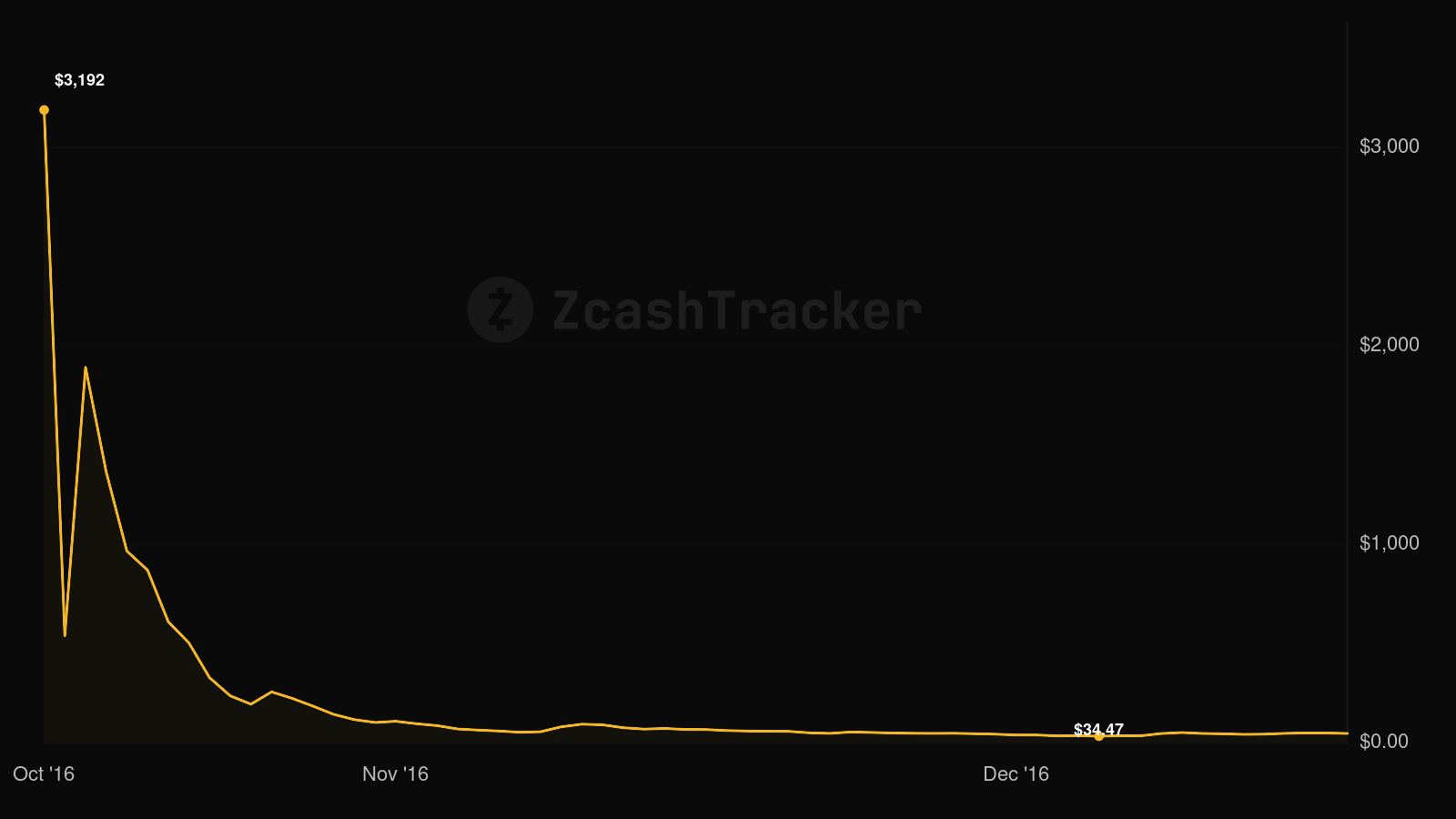
| Metric | Value |
|---|---|
| Launch-day spike | $3,191 (brief, varied by exchange) |
| Price range | Extreme volatility |
| Year-end price | $49 |
| Circulating supply | Extremely low |
| Inflation | Extremely high |
| Key event | Trusted setup ceremony |
Zcash launched in October 2016 with one of the most explosive debuts in crypto history. Its launch followed years of academic research into privacy-preserving cryptography led by Matthew Green and later developed by Zooko Wilcox and the Electric Coin Company.
On its first day of trading, ZEC briefly spiked to over $3,191 on some exchanges due to extreme scarcity and hype around its zero-knowledge privacy technology. However, this was short-lived, and as mining supply kicked in the price quickly collapsed below $100 as supply entered the market.
This volatility reflected early excitement around Zcash's promise: a cryptocurrency with strong, optional privacy built using cutting-edge cryptography. But as the heavy amount of mining supply entered the market, by the end of the year the price of Zcash was $49.
One of the most unique aspects of Zcash's launch was its trusted setup ceremony, a multi-party cryptographic process used to initialise its zk-SNARK system. Participants, later revealed to include Edward Snowden, ensured no single party could compromise the system. At the time of launch, the ceremony was deliberately secretive. Participants famously destroyed what is known as the "toxic waste", the private data that could theoretically compromise the system.
How Much Was 1 ZEC Worth in 2017?
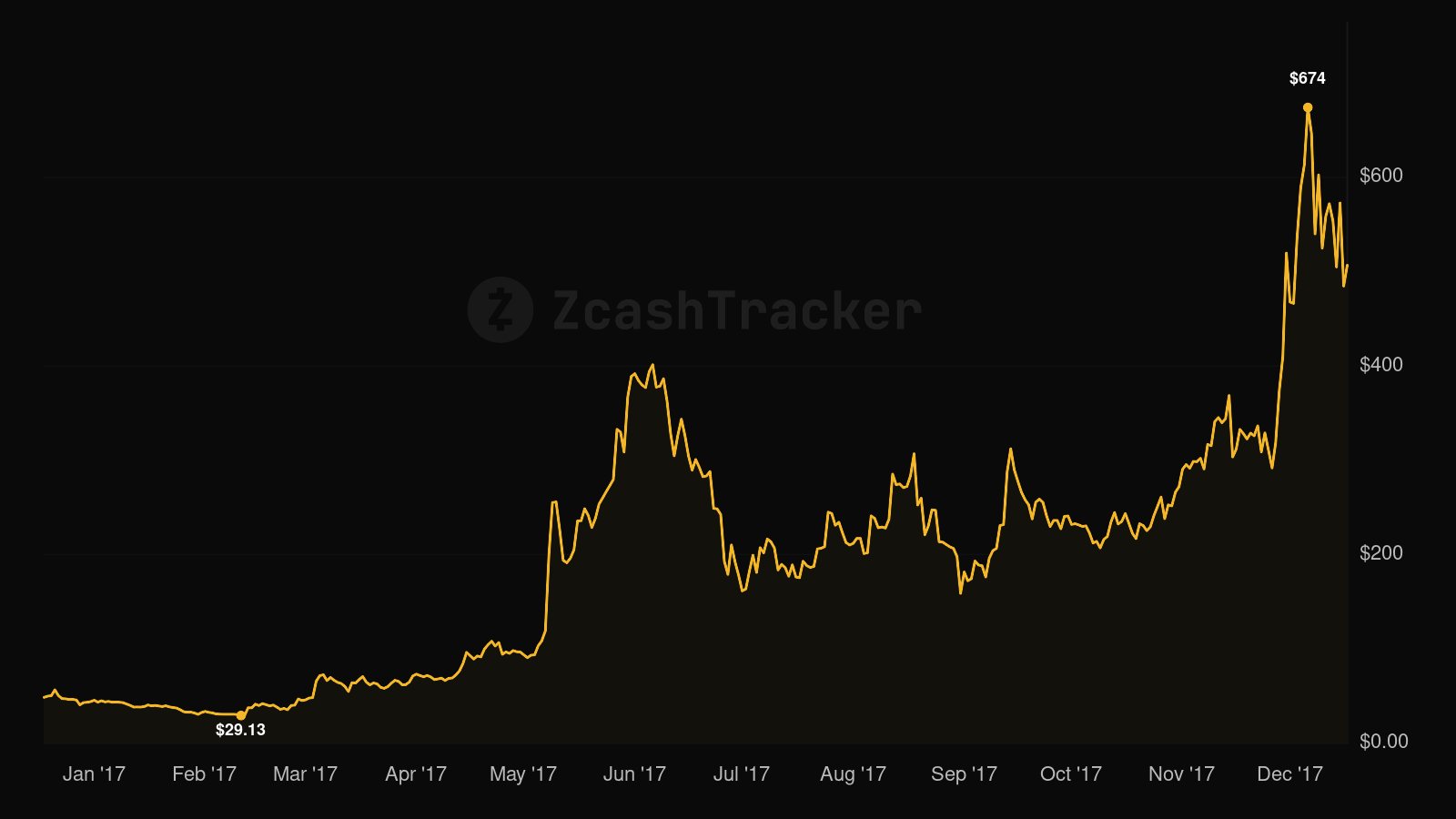
| Metric | Value |
|---|---|
| Price high | $780 |
| Price low | <$50 |
| Market trend | Strong bull cycle |
| Circulating supply growth | Rapid |
| Key event | JPMorgan zk-SNARK integration |
| Narrative | Institutional curiosity |
Zcash followed the broader crypto market rally in 2017, climbing from under $50 to highs above $780. The surge was driven by growing interest in privacy coins and listings on major exchanges like Bittrex, which improved accessibility.
In May 2017, ZECUSD broke through $100 and rallied up to $450. It then retraced, ranging between $150–$350 the rest of the year until it rallied hard in December with the rest of crypto up to its 2017 intra-day peak of $780.
Like much of crypto that year, the rally was fueled heavily by speculation rather than real-world usage. Interestingly though for Zcash specifically, it also gained early institutional validation. JPMorgan integrated Zcash's zk-SNARK technology into its Quorum blockchain. This was significant because it validated Zcash's cryptography at an enterprise level and positioned Zcash as more than just a speculative asset.
However, adoption lagged behind awareness because shielded transactions were still difficult to use, which meant that most transactions remained transparent. In 2017 less than 1% of Zcash was shielded. You can track how much Zcash is shielded on our shielded Zcash chart.
How Much Was 1 ZEC Worth in 2018?
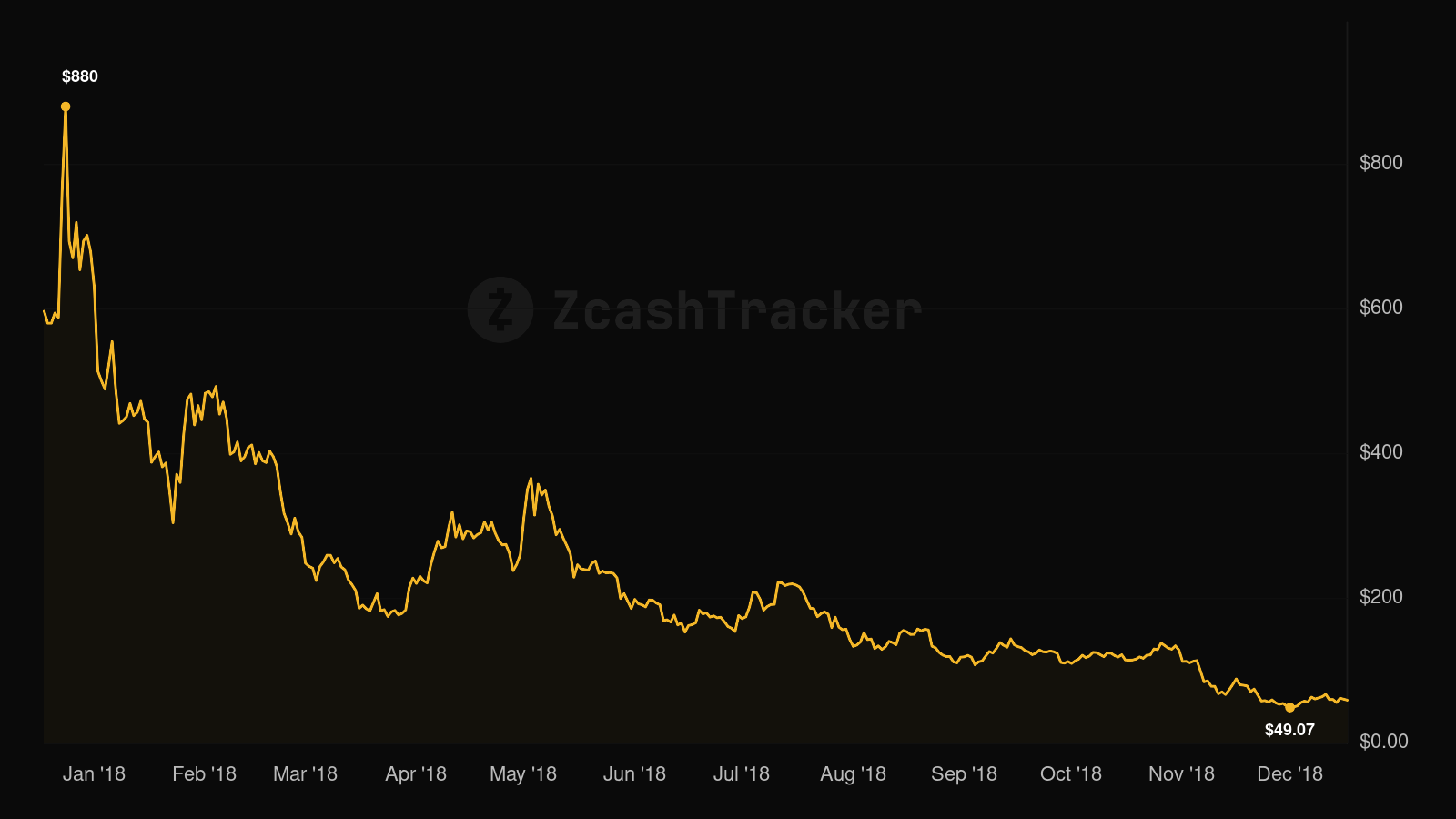
| Metric | Value |
|---|---|
| Price high | $806 |
| Price low | ~$46 |
| Market trend | Bear market |
| Key event | Sapling upgrade |
| Network impact | Major efficiency improvement |
| Narrative | Usability breakthrough |
2018 marked a brutal reversal, with ZEC falling over 80% from its highs. The broader crypto bear market hit privacy coins particularly hard, as regulatory concerns also began to surface. Governments and exchanges started questioning the role of anonymous transactions in financial systems.
From a January high of $806, price tumbled throughout the year all the way down to a December low of $46. Zcash faced three major headwinds: a crypto-wide bear market, high mining supply emissions bringing more supply onto the market, and regulatory concerns.
Despite the price decline, development on Zcash continued, laying the groundwork for future usability improvements. 2018 was one of the most important technical years for Zcash. The Sapling upgrade dramatically improved efficiency, making shielded transactions ~100x more efficient and finally usable on mobile devices.
How Much Was 1 ZEC Worth in 2019?
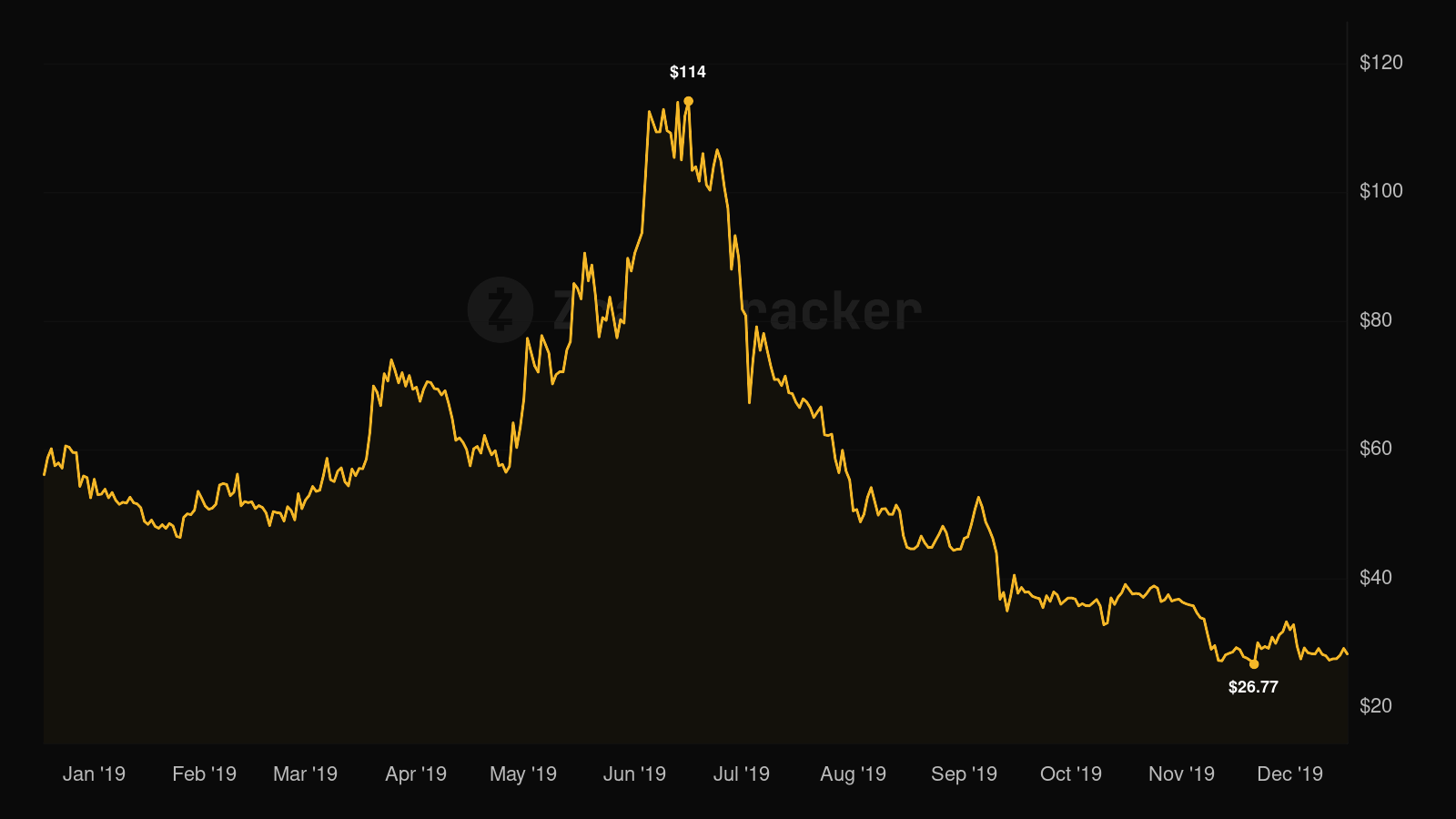
| Metric | Value |
|---|---|
| Price range | $26–$124 |
| Market trend | Volatile recovery |
| Key event | Halo research |
| Structural change | Removal of trusted setup |
| Narrative | Cryptographic evolution |
Zcash saw a modest recovery in 2019, briefly rising above $100 in June before fading again. There was heavy selling again throughout the rest of the year, with one ZEC priced as low as $25 in November.
A major reason for the selling was that FATF Travel Rule guidance was introduced in June. This guidance, requiring exchanges to share user data, was a seismic moment for crypto regulation and spelled trouble for privacy coins like Zcash. Then exchange delistings began, like Coinbase UK dropping Zcash in August 2019 and OKEx Korea delisting ZEC along with other privacy coins in September.
In addition, no halving had yet occurred for Zcash, which meant it still had a high inflation rate, resulting in about $400,000 in new coins being issued daily.
In 2019, one of the most important long-term developments occurred when legendary Zcash developer Sean Bowe introduced Halo, a method to eliminate trusted setups. This was a major evolution because it removed the need for future ceremonies and strengthened Zcash's long-term credibility. Additionally, Zcash Company rebranded to Electric Coin Company.
How Much Was 1 ZEC Worth in 2020?
| Metric | Value |
|---|---|
| Price range | ~$20–$100 |
| Key event | First halving |
| Block reward change | −50% |
| Inflation | Reduced significantly |
| Upgrade | Canopy |
| Narrative | Structural shift |
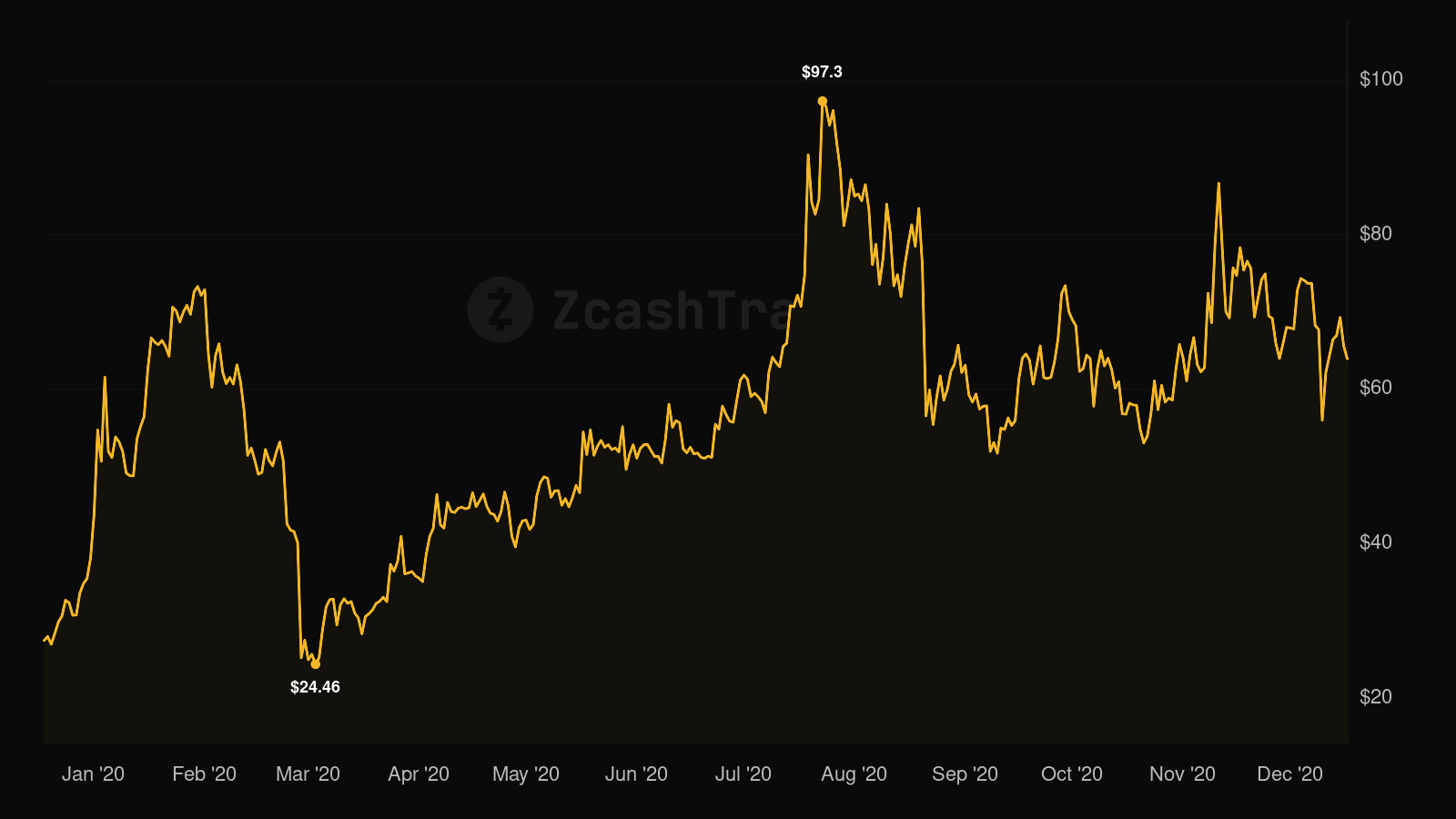
Zcash price tumbled in March 2020 as the COVID crash hit markets. For ZECUSD this meant a price drop to as low as $18 on Friday 13 March. After that, ZEC rallied for several months, reaching a high of $100 in August.
The price of Zcash then stabilised for the rest of the year as the first Zcash halving took place on 18 November 2020. This block reward reduction of 50% significantly reduced inflation. Initial response to the halving was limited, but it contributed to the price appreciation that was soon coming in early 2021.
2020 also marked a broader shift in how people thought about privacy. During COVID lockdowns, digital payments surged, governments expanded financial monitoring, and economic stimulus increased money supply globally. This led to a growing awareness that financial systems were becoming more transparent and trackable. Within this context, Zcash's value proposition became clearer: not just as a speculative asset, but as a tool for private, censorship-resistant transactions.
How Much Was 1 ZEC Worth in 2021?
| Metric | Value |
|---|---|
| Daily close price high | $320 |
| Market trend | Bull cycle |
| Adoption | Increasing |
| Key event | China mining ban |
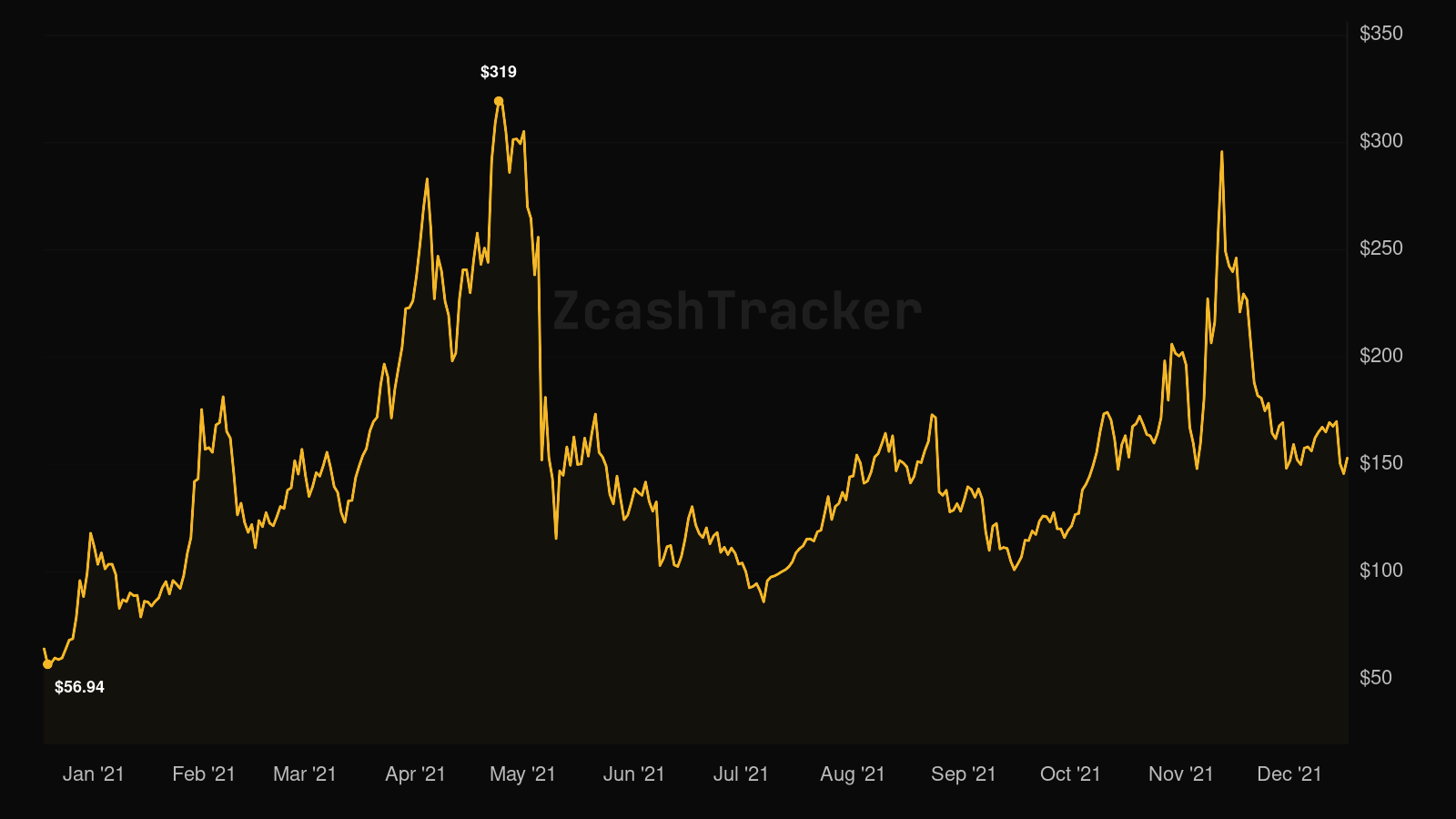
Zcash benefited from the broader crypto bull market in the first five months of 2021, reaching daily close highs of $320 in May 2021. But it underperformed relatively as capital rotation saw speculative capital leave privacy coins like Zcash and move into DeFi and NFTs, which captured the crypto narrative throughout 2021.
It saw a sharp price drop in May 2021 with China's crypto mining ban, which negatively impacted proof-of-work (PoW) coins like Bitcoin and Zcash. That news significantly contributed to the fall of ZECUSD, which reached a low of $85 in June, before rallying up again with the rest of the market later in the year.
The final crypto market bull run surge later in the year saw Zcash also benefit as it reached a daily close high of $295 in November 2021.
How Much Was 1 ZEC Worth in 2022?
| Metric | Value |
|---|---|
| Price range | ~$22–$211 |
| Market trend | Bear market |
| Key event | NU5 upgrade |
| Key feature | Orchard pool |
| Structural shift | No trusted setup |
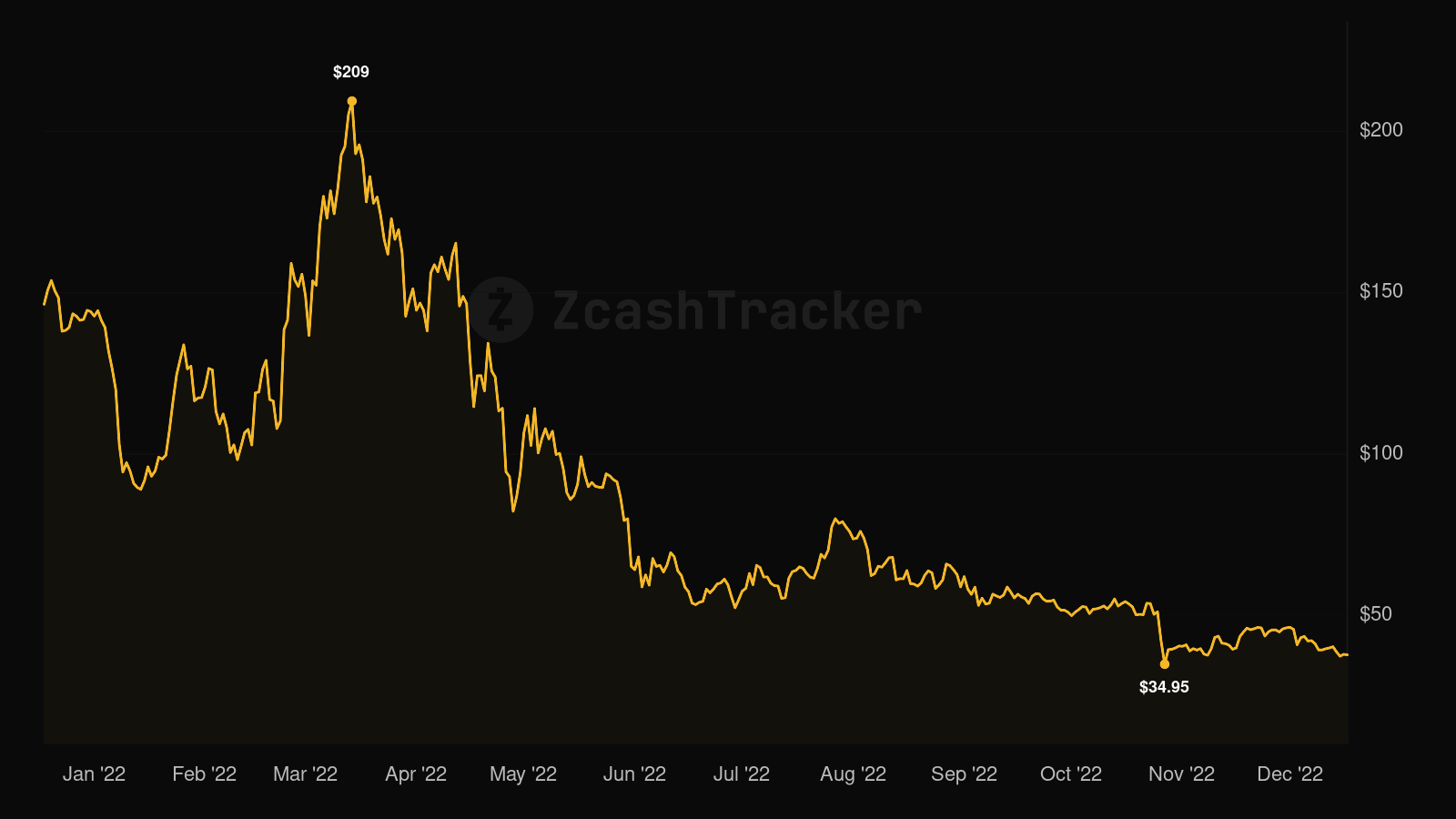
ZEC declined alongside the wider market in 2022 as the bear market took hold and the implications of the Terra/Luna collapse and FTX implosion became clear. After a brief rally up to $211 in March 2022, ZECUSD tumbled throughout the rest of the year, reaching a low of $22 in November 2022.
In August 2022, OFAC sanctioned Tornado Cash, alleging it facilitated the laundering of over $7 billion in cryptocurrency, including funds stolen by North Korea's Lazarus Group. This was a huge shock to the entire privacy/anonymity sector. If the US government could sanction open-source privacy code, many investors wondered whether Zcash itself was perceived as being in the crosshairs.
Meanwhile, ZEC was still inflating at 6–7% annually post the Nov 2020 halving, which added further miner sell pressure. However, 2022 also introduced one of the most important upgrades in Zcash history: NU5 (Halo Arc). This enabled the Orchard shielded pool, unified addresses, and removal of the trusted setup. This marked a major milestone as it meant Zcash became fully trustless in its privacy model.
How Much Was 1 ZEC Worth in 2023?
| Metric | Value |
|---|---|
| Price range | $20–$50 |
| Key event | 51% hash rate concern |
| Narrative | Network resilience |
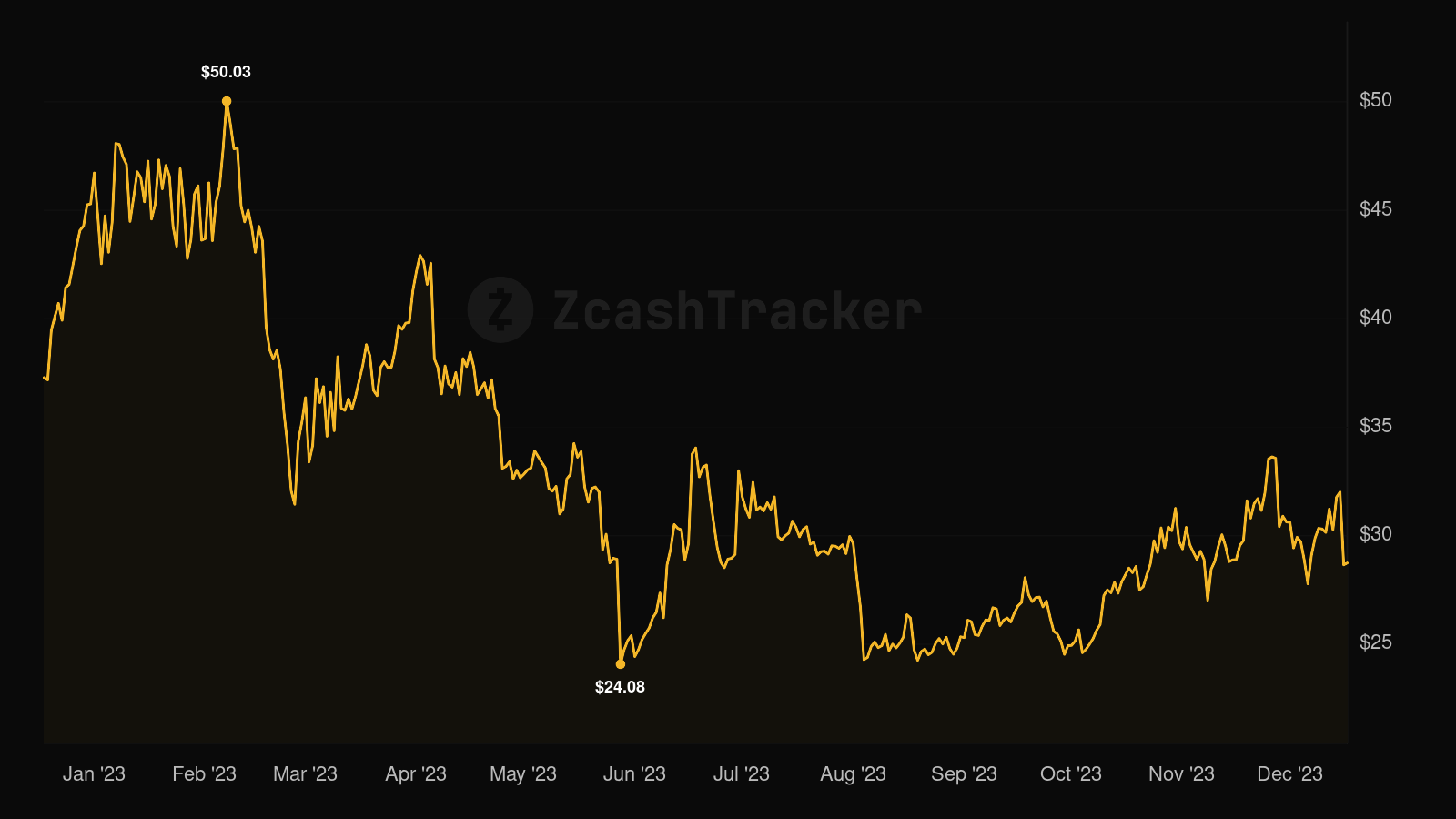
After a February 2023 high of just $50, Zcash spent much of 2023 trending lower in a broad range of $20–$50 as the crypto bear market continued. There were also specific troubles for Zcash as the SEC opened an investigation into the Zcash Foundation via subpoena in August 2023, which added regulatory uncertainty on top of the bear market.
In September 2023, Zcash faced a critical moment. Coinbase reported that the mining pool ViaBTC briefly controlled over 50% of Zcash's network hash rate, triggering concerns about a potential 51% attack. When a single mining pool exceeds 50% of hash rate, it theoretically gains the ability to reorganise blocks, double-spend coins, and disrupt network consensus. This is known as a 51% attack, and it's one of the most discussed risks in proof-of-work systems.
Despite this, no attack occurred, the hash rate distribution gradually normalised, and the network remained stable. However, the incident did little to support positive price appreciation of Zcash.
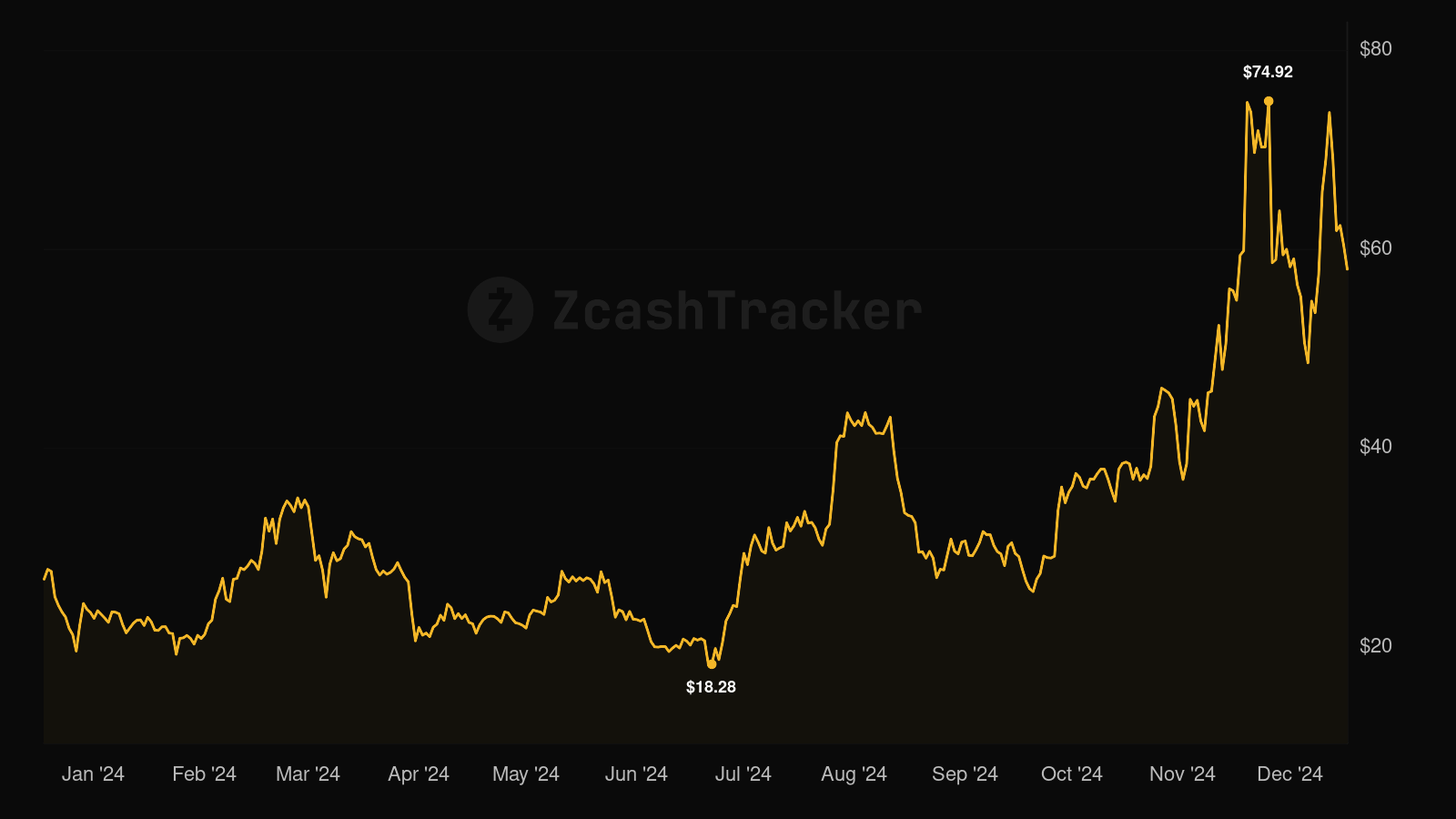
How Much Was 1 ZEC Worth in 2024?
| Metric | Value |
|---|---|
| Price low | $16 |
| Price high | $75 |
| Narrative | Next-gen privacy |
| Key event | November halving |
For the first half of 2024, the price of Zcash continued to trend downwards, dropping to an all-time low of $16 in July 2024, representing a 99.7% drawdown from launch-day highs and a 98% drawdown from the 2018 cycle peak.
However, the second half of 2024 marked a major change for Zcash, with several favourable tailwinds emerging. The second Zcash halving occurred in November 2024. This led to considerable price appreciation as the market anticipated the impact of the inflation reduction, sending price rallying up to a daily close high of $74 in early December 2024.
An important milestone development in 2024 was the launch of the Zashi wallet (now rebranded to ZODL wallet). ECC's new CEO Josh Swihart shifted focus to consumer UX and built Zashi, which made shielded transactions the default. Once launched, shielded transactions and ZEC in shielded pools grew exponentially, from roughly 5% to over 20% of supply within a few months.
In terms of governance, 2024 was a defining year for Zcash. Historically two institutions controlled the governance and received the funding for Zcash: the Electric Coin Company and the Zcash Foundation.
In May 2024, ECC (Electric Coin Company) announced it would no longer accept direct funding. The legacy model of automatic funding could not survive its largest beneficiary refusing to participate. Network Upgrade 6 (NU6) cut direct funding and routed 8% to Zcash Community Grants (ZCG) for ecosystem grants and 12% into a protocol-controlled lockbox for ZEC holders to retroactively distribute grants to those delivering impactful benefits.
This model is explicitly time-limited. Both the 8% and 12% funds expire at the end of the third halving in late 2028. The community could renew them, but this is by no means a given, as there must be overwhelming consensus across the community that they should be continued in any way.
Then, in August 2024, ECC served formal notice of termination of the trademark agreement that gave ECC and the Zcash Foundation 2-of-2 multisig control over the protocol. Six months later, the Zcash Foundation announced that it would not use the trademark for governance. The stranglehold on Zcash governance was broken, and coin holders and other groups across the ecosystem were able to be heard. Now there is no single body that has a monopoly on determining community sentiment. Zcash governance was set free.
How Much Was 1 ZEC Worth in 2025?
| Metric | Value |
|---|---|
| Supply pressure | Falling |
| Inflation | Decreasing |
| UX | Improving |
| Narrative | Structural shift |
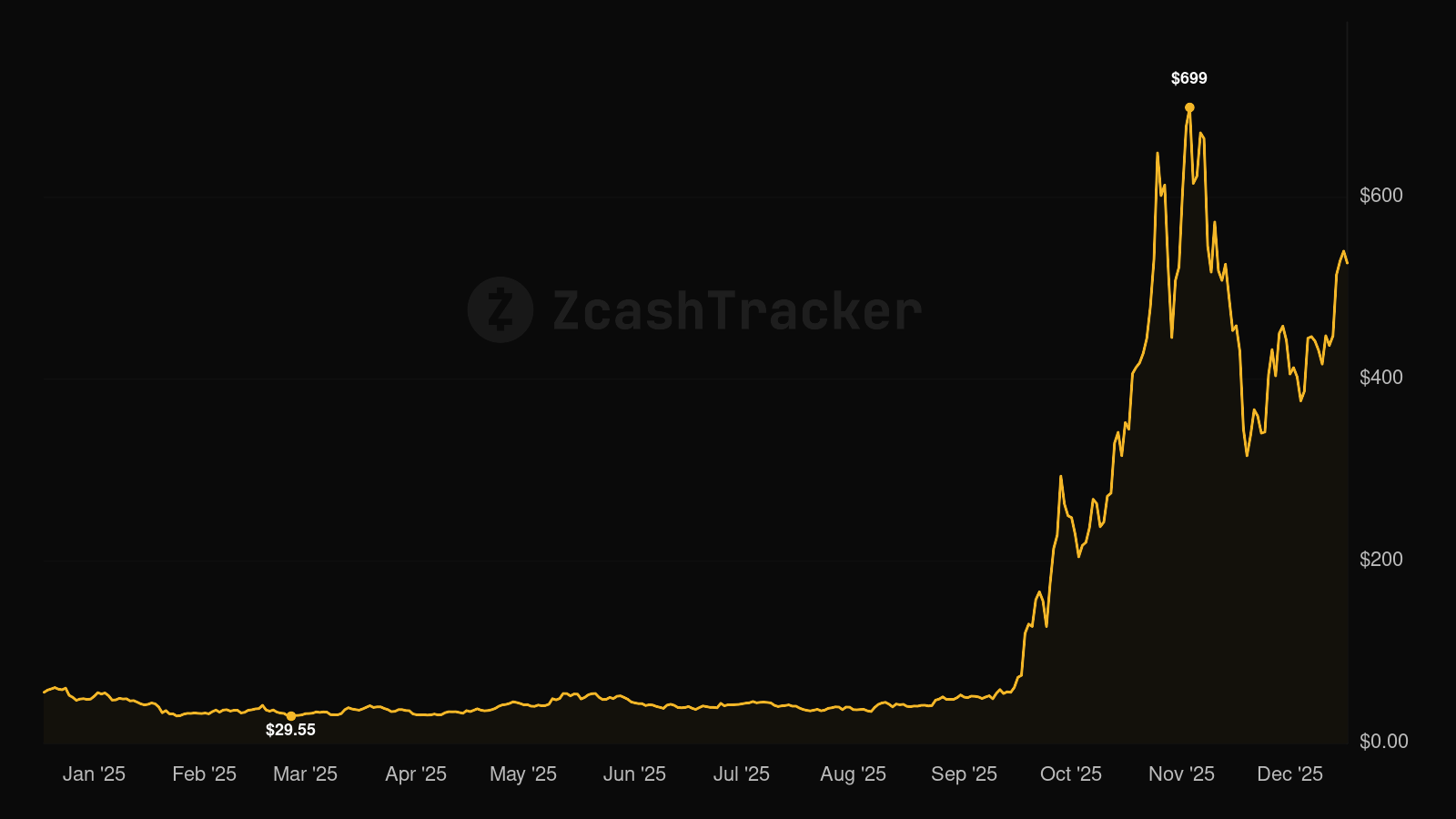
2025 was one of the most explosive years in Zcash's history since its launch. The groundwork laid in 2024 in terms of governance and user enhancements began to pay off. ZEC began the year trading at relatively low levels, reaching an intra-day low of $25 in February 2025.
However, over the course of the year it experienced a massive rally of nearly 3000%, making it one of the best-performing assets in crypto in 2025.
By October and November, the move turned parabolic. On 1 October 2025, Zcash broke above $100. It then surged all the way to intra-day highs between $700–$740 in November 2025, driven by renewed interest in Zcash.
Prominent influencers like Balaji Srinivasan (former a16z CTO), Mert Mumtaz (Helius CEO), Naval Ravikant and others published articles and posts supporting Zcash, which further amplified market sentiment. Balaji referred to Zcash when discussing the need for "HTTPS-level" privacy in crypto, stating: "we're going to go to the one to infinity moment where financial privacy is just a human right." Naval really ignited market enthusiasm for Zcash with his post: "Zcash is insurance against Bitcoin."
Institutional-style accumulation also played a role. The Winklevoss-backed treasury company Cypherpunk publicly accumulated large amounts of ZEC, signalling growing conviction in privacy-focused assets. Grayscale also reopened its Zcash Trust for private placement during the rally, providing one of the few compliant channels for institutional capital to gain direct ZEC exposure, with assets under management reaching approximately $85 million.
A key infrastructure development was the launch of CrossPay in September 2025, which integrated Zcash's Zashi wallet with NEAR Intents to enable cross-chain swaps directly into shielded ZEC. At the end of 2025, the price of Zcash was $510.
How Much Was 1 ZEC Worth in 2026?
| Metric | Value |
|---|---|
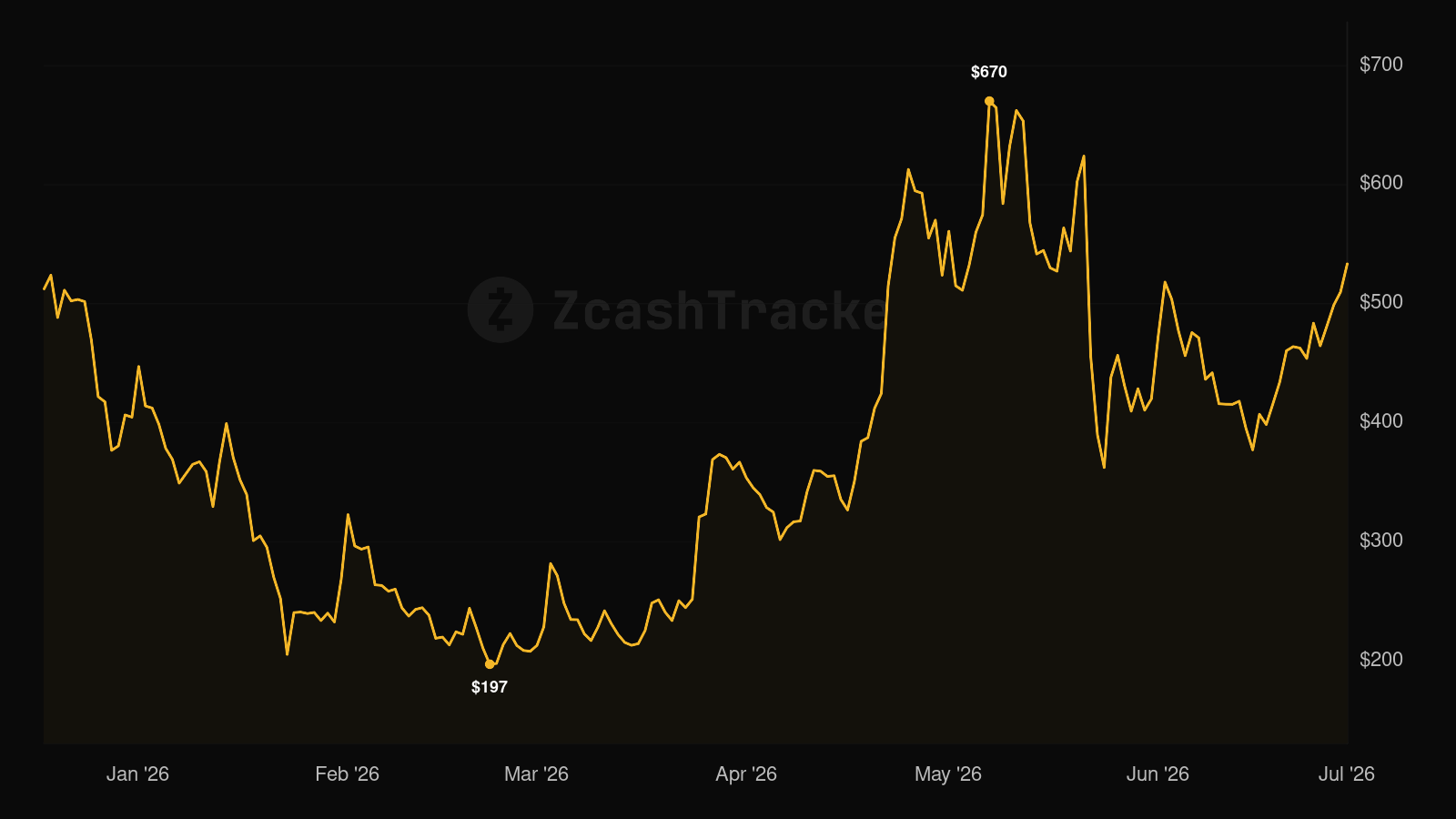
| Price range | $180–$510 |
| Market trend | Correction from 2025 highs |
| Key event | ZODL $25M raise |
| Key event (2) | SEC closes Zcash Foundation investigation |
| Narrative | Institutional validation |
Zcash entered 2026 trading around $510 following its explosive 2025 rally, but faced a significant correction in the early months of the year as the broader crypto market pulled back and profits were taken after the parabolic move.
In January 2026, the SEC formally closed its multi-year investigation into the Zcash Foundation without taking any enforcement action. The probe, initiated via subpoena in August 2023, had examined whether ZEC constituted a securities offering. Its closure removed a major regulatory overhang that had weighed on sentiment for over two years.
That same month, the Winklevoss twins donated $1.2 million in ZEC to Shielded Labs, their second contribution to the independent Zcash development organisation. The funds are supporting protocol-level work including the Network Sustainability Mechanism, Crosslink (a hybrid PoW/PoS layer), and Dynamic Fees.
A major governance shift also occurred in January when the entire engineering and product team at Electric Coin Company resigned following a dispute with Bootstrap, the nonprofit board overseeing ECC. Led by former CEO Josh Swihart, the team formed the Zcash Open Development Lab (ZODL) and in March raised over $25 million in seed funding from Paradigm, a16z crypto, Winklevoss Capital, Coinbase Ventures, and individual investors including Balaji Srinivasan. ZODL now maintains the ZODL wallet (formerly Zashi) and continues core Zcash protocol development independently.
Despite the price pullback from 2025 highs, on-chain fundamentals remained strong. The shielded pool held at record levels above 5 million ZEC, representing roughly 30% of total supply, and network hashrate reached all-time highs.
FAQ
What is the price of 1 ZEC today?
The current price of Zcash is displayed at the top of this page and updates in real time. ZEC trades 24/7 on global cryptocurrency exchanges, so the price is constantly changing based on supply, demand, and broader market conditions. You can track live Zcash data at zcashtracker.com.
What was Zcash's highest price ever?
On its very first day of trading in October 2016, ZEC briefly spiked above $5,000 on some exchanges due to extremely low circulating supply and intense hype. However, this was not sustainable. In terms of sustained price levels, Zcash reached daily close highs above $780 during the 2017 bull market and above $800 in early January 2018. In 2025, ZEC reached intra-day highs between $700–$740 during its privacy-narrative-driven rally.
What was Zcash's lowest price ever?
ZEC hit an all-time low of approximately $16 in July 2024 during a prolonged bear market. This came after years of declining interest in privacy coins, ongoing exchange delistings, and sustained miner sell pressure from inflation that had not yet been sufficiently reduced by halvings.
Why is Zcash price so low compared to Bitcoin?
Several factors have historically weighed on ZEC's price relative to Bitcoin. Zcash had a much higher inflation rate in its early years, meaning large amounts of new supply entered the market constantly. Privacy coins have also faced regulatory headwinds including exchange delistings driven by FATF Travel Rule guidance. Additionally, Zcash lacks the network effects, institutional adoption, and brand recognition that Bitcoin has built over a longer period. However, Zcash's inflation is now decreasing with each halving, bringing its supply dynamics closer to Bitcoin's over time.
How does the Zcash halving affect price?
Zcash halvings reduce the block reward paid to miners by 50%, cutting the rate at which new ZEC enters circulation. The first halving occurred in November 2020, and the second in November 2024, reducing the block reward to 1.5625 ZEC. Historically, halvings have contributed to price appreciation as reduced sell pressure from miners coincides with steady or growing demand. The next Zcash halving is expected in late 2028.
What affects Zcash price the most?
ZEC price is influenced by several factors: the broader crypto market cycle, supply dynamics including halvings and mining inflation, regulatory developments around privacy coins, adoption of shielded transactions, and narrative momentum from influential voices in the crypto space. The 2025 rally demonstrated how quickly sentiment can shift when privacy narratives gain traction.
Is Zcash a good investment?
Zcash is a volatile cryptocurrency and, like all crypto assets, carries significant risk. Its price has experienced drawdowns of over 95% from highs. Factors that could support long-term value include its decreasing inflation schedule, growing shielded transaction adoption, and increasing demand for financial privacy. Factors that could weigh on it include regulatory action against privacy coins, competition from other privacy technologies, and its relatively small market compared to Bitcoin or Ethereum. This page does not provide financial advice — always do your own research.
What happens when all Zcash is mined?
Zcash has a fixed maximum supply of 21 million coins, identical to Bitcoin. New ZEC is created through mining, with the reward halving approximately every four years. At the current pace, the last ZEC will be mined well into the 2100s. As block rewards decrease over time, miners will increasingly rely on transaction fees to sustain operations. Proposals like Zcash's Network Sustainability Mechanism are exploring ways to ensure long-term network security as block rewards diminish.