Zcash Privacy Explained: How Private Is Zcash?


Privacy is one of the most misunderstood concepts in cryptocurrency. While many people assume crypto is anonymous by default, most blockchains are fully transparent. Zcash was created specifically to address this gap, offering users the option to transact with strong, cryptographic privacy guarantees.
This page explains how Zcash privacy works, how it compares to Bitcoin, and what makes Zcash unique among privacy-focused cryptocurrencies.
Why Privacy Matters in Cryptocurrency
Public blockchains like Bitcoin allow anyone to inspect:
- Wallet balances
- Transaction history
- Sender and receiver addresses
Once an address is linked to a real identity, through an exchange, merchant, or data leak, financial privacy is permanently lost.
This creates risks such as:
- Loss of personal financial confidentiality
- Address blacklisting and surveillance
- Targeting, profiling, or censorship
Zcash was designed to solve this problem at the protocol level.
Is Zcash Private?
Yes - Zcash supports fully private transactions, but privacy is optional, not mandatory.
Zcash offers two types of addresses:
Transparent Addresses (t-addresses)
- Similar to Bitcoin addresses
- Sender, receiver, and amount are publicly visible
- Useful for compatibility and exchanges
Shielded Addresses (z-addresses)
- Sender, receiver, and transaction amount are encrypted
- Transaction validity is proven using zero-knowledge cryptography
- Blockchain observers cannot see transaction details
When Zcash is used with shielded addresses, it provides strong on-chain privacy guarantees.
How Zcash Privacy Works (In Simple Terms)
Zcash uses zero-knowledge proofs, specifically zk-SNARKs, to prove that a transaction is valid without revealing any private information.
A shielded transaction proves:
- The sender owns the funds
- The funds are not double-spent
- The transaction balances correctly
…without revealing:
- Who sent it
- Who received it
- How much was sent
The blockchain verifies correctness without seeing the data itself.
Shielded Transactions Explained
In Zcash, shielded transactions work using cryptographic “notes” rather than visible balances.
Each note:
- Represents value
- Is encrypted on-chain
- Can only be spent by the owner with the correct key
When a note is spent:
- A cryptographic proof confirms it hasn’t been spent before
- No transaction history is exposed
- No linkability is created between transactions
This means observers cannot trace funds through the network.
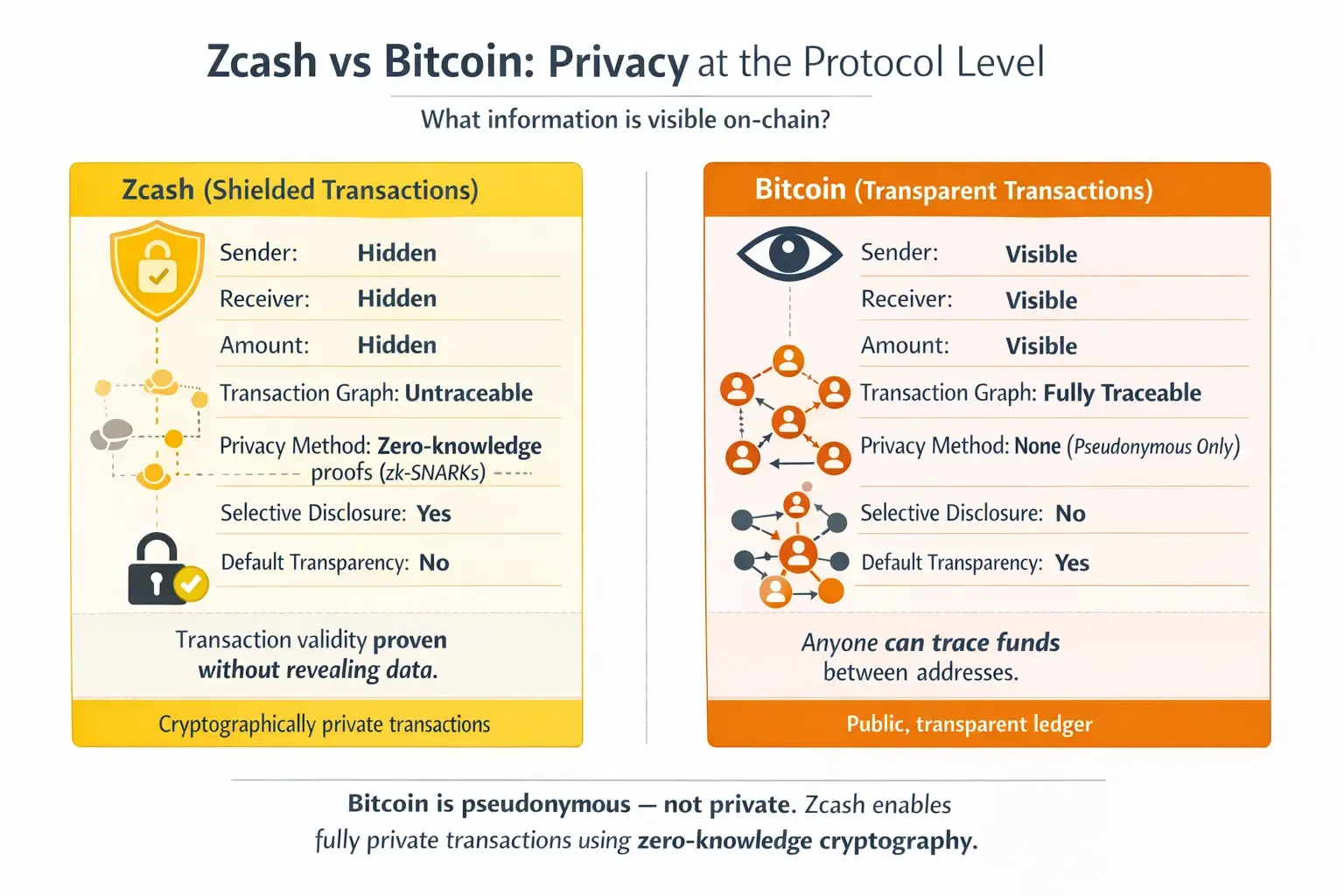
Zcash vs Bitcoin: Privacy Comparison

Feature | Bitcoin | Zcash (Shielded) |
Transaction amounts visible | Yes | No |
Sender & receiver visible | Yes | No |
Transaction graph traceable | Yes | No |
On-chain privacy | Weak | Strong |
Optional transparency | N/A | Yes |
Bitcoin is pseudonymous, not private.
Zcash, when used correctly, provides true cryptographic privacy.
Zcash vs Other Privacy Coins
Zcash takes a different approach to privacy compared to other privacy-focused cryptocurrencies.
Key distinctions:
- Privacy is enforced through cryptography, not obfuscation
- Transactions do not rely on mixing or ring signatures
- Privacy does not degrade with network analysis over time
Zcash’s privacy model allows users to selectively disclose information if needed, which can be useful for audits or compliance — something not possible with all privacy coins.
Is Zcash Privacy Auditable or Provable?
Yes. One advantage of Zcash’s design is selective disclosure.
Users can:
- Share view keys with auditors
- Prove payment without revealing full history
- Maintain privacy while meeting reporting requirements
This makes Zcash suitable for both personal privacy and institutional use cases.
Common Misconceptions About Zcash Privacy
“Zcash isn’t private because not all transactions are shielded”
Privacy is opt-in by design. Shielded transactions remain private regardless of transparent usage elsewhere.
“Privacy coins are illegal”
Privacy itself is not illegal. Financial privacy tools exist across traditional finance and cryptography.
“Zcash privacy is weaker than alternatives”
Zcash privacy is cryptographically enforced and does not rely on probabilistic anonymity sets.
The Long-Term Role of Zcash Privacy
As blockchain adoption grows, transparency becomes a double-edged sword. Without privacy:
- Businesses expose revenue flows
- Individuals expose spending behavior
- Entire economies become surveilled
Zcash provides a model where:
- Privacy is available by default when needed
- Transparency remains optional
- Users control their financial visibility
This balance is central to Zcash’s long-term relevance.
Key Takeaways
- Zcash offers true on-chain privacy via shielded transactions
- Privacy is optional but cryptographically strong
- Zcash protects sender, receiver, and transaction amount
- Bitcoin is transparent; Zcash can be private
- Zcash allows selective disclosure for audits and compliance